Antoni Gaudi | Biography, works and words
antonigaudi.org Document search:

The Architect of the Holy Family
Anton Gaudí i Cornet was born in Reus (Catalonia) on June 25, 1852. He was a sick child, which it prevented him from representing to class and forcing him to pass long seasons in Riudoms's family farmhouse, where he caught the Mediterranean light and the images of the Nature, which he always would consider his great teacher. Besides, helping his father in his boiler making workshop he learned the virtues of the work and the transformation of the surfaces in volume, which facilitated very much his spatial imagination.
He studied the high school in the Piarist Fathers of Reus. During the Glorious Revolution of 1868, he moved to Barcelona to study Architecture, the passion of his life. It was an evil pupil, but he was passing hours looking at photographies of oriental buildings and he was frequenting classes of Philosophy, of Aesthetics and of History, as well as the concerts, the classic and modern theatre, the poetical readings, the intellectual gatherings and the visits to all the monuments and Catalonia's landscapes. Gaudí became one of the big figures of the Catalan renascence, called the “Reinaxença”.
To be kept, he had to work, and he collaborated as draftsman with engineers and architects, as Josep Fontseré, author of the park of the Citadel; Francisco del Villar, restorer of Montserrat; or Joan Martorell, architect of the Jesuits, the Saleses and other big churches.
In 1878, on having finished, the director of the Architecture School commented: «Today we have given the architect's degree to a madman or to a genius».
Gaudí was conscious from very young man of his role of genius of the art, of which his ideas were not a repetition or a mere continuity of what had made the architects till then. The only thing that he was scaring was that no other architect had put into practice before and he had to be the first one. He had studied and discovered the geometric and constructive laws with which it’s made the Nature —the masterpiece of the Creator— and he was trying to realize his art with the same models; it is to say, not to copy to the Creation, but to continue his course, to cooperate with the Creator. It is what he was saying: «Originality consists of returning to the origin».
He knew then Eusebi Güell i Bacigalupi (1878), important businessman with great artistic sensibility that he understood to Gaudí and was constituted in one of his better friends and his principal client along his life: the doors of the Güell Estate (1884-1887), the house Güell (1888), the Güell cellars (1895-1897), the refuge on the Catllaràs (1905) and both more creative works of the maturity of the artist: the Park Güell (1900-1914) and the crypt of the church of the colony Güell (1908-1917).
Gaudí, to the death of his brother Francesc, of his sister Rosa and of his mother, took charge of his orphan niece Rosita and of his elderly father Francesc. He supported loving relations with Miss Pepita Moreu, who was paid in failure. Other women would cross later in his life, but Gaudí finally did not marry.
Of young man, he lived very closely and studied thoroughly the labor’s problems and especially of the lamentable conditions of life of the workers. It is the moment of the I International, with the socialistic trend of Marx and the anarchist of Bakunin. Gaudí was an architect of the Cooperative Mataronense (1874-1885), which it was supporting to join the capital and the work at an alone element: the cooperative worker. The Cooperative Mataronense was the Catalonia’s first factory and one of the first ones of the world property of its workers.
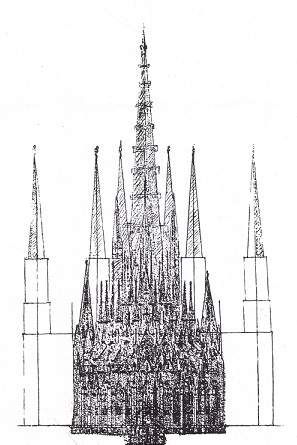
At the age of 31, in 1883, Gaudí received the order of continuing the works of the Sagrada Família, upset begun. He moved there his office and shared feelings with the religious and artistic purpose of the Holy Family. For forty three years, up to his death, Gaudí would dedicate all his energies to developing in the project of this big church his ideas on structure, form and symbolism, bankrupts in a perfect synthesis of rational forms extracted from the Nature.
Gaudí had friendship with some clergymen innovative of the social reforms and of the liturgical reform. The poet father Jacinto Verdaguer; bishop Joan Baptista Grau from Astorga, who entrusted him the palace (1887-1893); father Enric d'Ossó, founder of the congregation of St. Teresa of Jesus, who entrusted him the central college (1888-1889); bishop Pere Campins from Majorca, who entrusted him the reform of the cathedral (1903-1914); etc. Over all, emphasizes the friendship with bishop Josep Torras i Bages, from Vic, ideologist and entertainer of the Christian wing of the Catalan Renaixença.
Simultaneous with
his work on the Sagrada Família Gaudí made his other orders, big and small, not only ecclesiastics or for Güell, but of other clients, as “The Caprice” (1883-1885), the house Vicens (1883-1888), the house Calvet (1898-1899), the house Batlló (1904-1906), Bellesguard (1900-1909) and “The Quarry” (1906-1911).
His religiousness was intensified progressively. This way, during Lent, 1894, at the age of 42, the fasting was on the verge of causing the death. In 1906, at the age of 54, he moved to live through the Park Güell, at the top of Gràcia neighbour. Every morning he was going down walking from his house to Saint John’s parish inside Gràcia to take part in the Eucharist and then he was continuing up to the Sagrada Família. Every evening, on having ended the work, Gaudí was coming to the Oratory of St. Philip Neri to realize his personal devotions and to speak with his spiritual director, father Agustí Mas. With the conviction of which without sacrifice it is impossible to extract forward a work, he submitted to a life of penance and voluntary poverty.
Gaudí had exposed his desire to die in the Christian charity’s hospital, as one more poor person. God granted this desire to him. On Monday, the 7th of June, 1926, he knocked down a streetcar. And on not having been recognized and dressed simply, they took it as poor person to the Holy Cross hospital. Three days later, on the tenth of June, surrounded with his friends, he said his last words: «Amen. My God! My God!».
His funeral was a giant manifestation, which accompanied the corpse from the hospital up to the crypt of the Holy Family, where he is buried.
Josep Maria Tarragona, March 10, 2006